
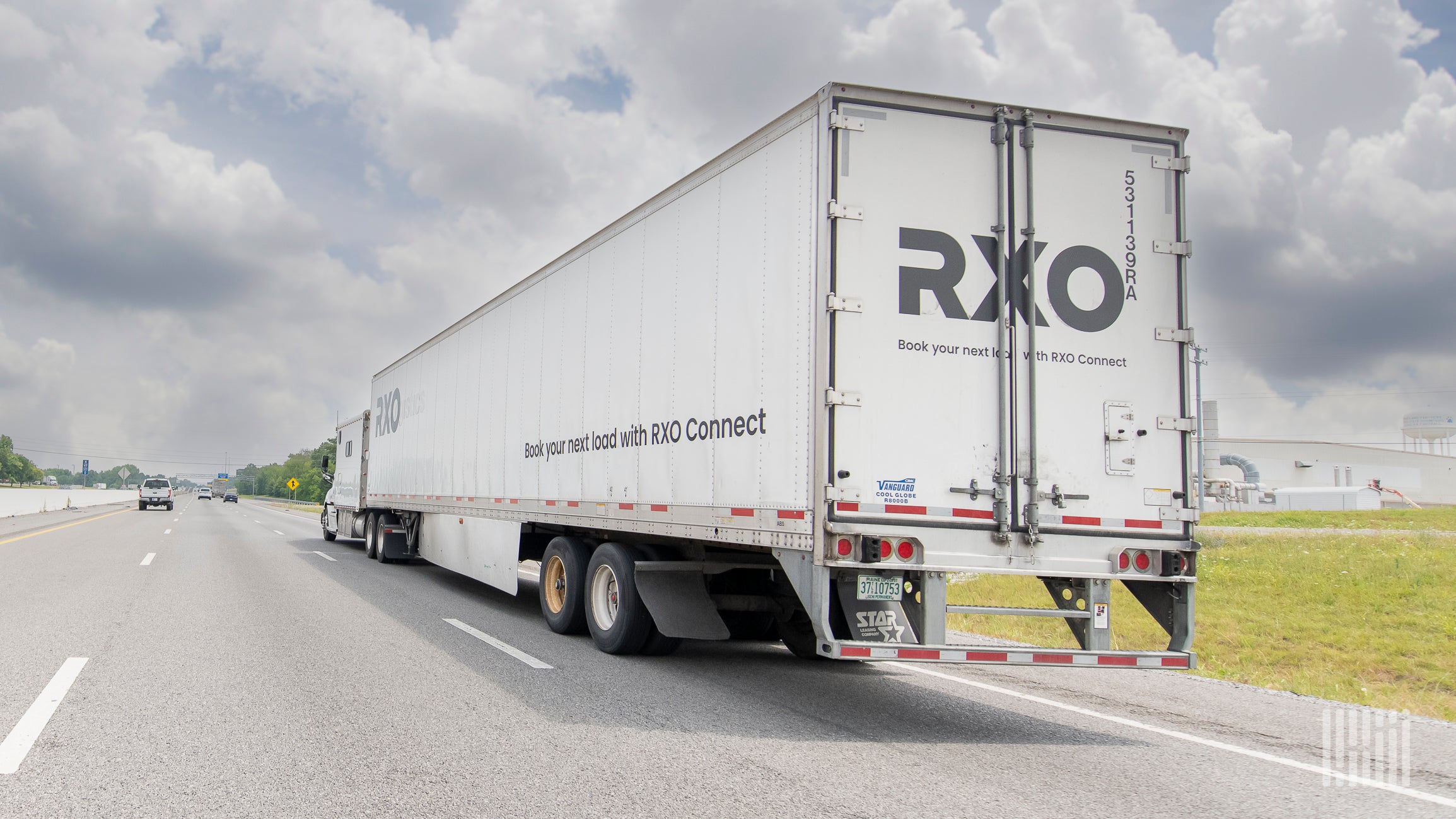
While many of RXO’s year-over-year financial numbers showed little improvement or moved in the wrong direction, the company pointed to stronger freight volumes, a higher truckload spot mix and improved profit per load as signs that conditions are beginning to move in its favor.
On a GAAP basis, RXO reported a net loss of 5 cents per share for the quarter. That was unchanged from the same period a year earlier, but a significant improvement from the 21-cent-per-share loss reported during the first quarter.
RXO said its GAAP results were affected by transaction, integration and restructuring expenses, along with amortization of intangible assets and other costs.
Adjusted EBITDA came in at $40 million, up slightly from $38 million a year ago. The number also represented a major improvement from the first quarter, when RXO reported just $6 million in adjusted EBITDA.
The company’s adjusted EBITDA margin came in at 2.3%, compared with 2.7% a year earlier. However, that was still well above the 0.4% margin reported during the first quarter.
Freight volumes show signs of improvement
Some of the strongest numbers highlighted by RXO came from its truckload brokerage operation.
The company said it recorded a “historic” sequential increase in profit per load, marking its strongest improvement in four years. RXO attributed much of that increase to a major shift toward the truckload spot market.
Spot freight accounted for 42% of RXO’s truckload business during the second quarter, up from 33% in the first quarter. Compared with the same period last year, the company’s spot mix increased by 1,500 basis points.
That higher spot exposure helped improve gross profit per load.
RXO also reported truckload volume growth of 2% year over year, another sign that the stronger freight market is beginning to provide some support for the brokerage.
Third-quarter outlook remains cautious
Despite the sequential improvements, RXO’s third-quarter guidance suggests profitability could remain relatively flat.
After reporting $40 million in adjusted EBITDA during the second quarter, the company expects third-quarter adjusted EBITDA to fall somewhere between $35 million and $45 million.
RXO also expects truckload gross profit per load to improve again sequentially.
Truckload volumes are projected to grow by a low-to-mid-single-digit percentage compared with the same period last year.
Carrier vetting remains in focus
RXO CEO Drew Wilkerson also pointed to the company’s carrier selection and cargo security practices while discussing the quarter’s results.
“We achieved these results with strong carrier vetting and cargo security practices,” Wilkerson said.
The comments come as freight brokers face increased attention over how they select and approve motor carriers following the Supreme Court’s Montgomery v. Caribe Transport II decision.
The issue has become even more closely watched following a recent nuclear verdict against C.H. Robinson in Texas, raising concerns across the brokerage industry about potential legal exposure tied to carrier selection.
RXO did not directly address the Montgomery decision in its earnings release.
RXO shares remain volatile
RXO’s stock has experienced a major swing over the past year.
Shares climbed from a 52-week low of $10.43 in November to $29.90 on July 21.
More recently, concerns surrounding the legal environment for freight brokers helped push the stock lower, with RXO closing Wednesday at $21 per share.
However, early premarket trading Thursday pointed toward a possible rebound. RXO shares were up more than 9% around 5 a.m. EDT ahead of the company’s earnings call with analysts.