
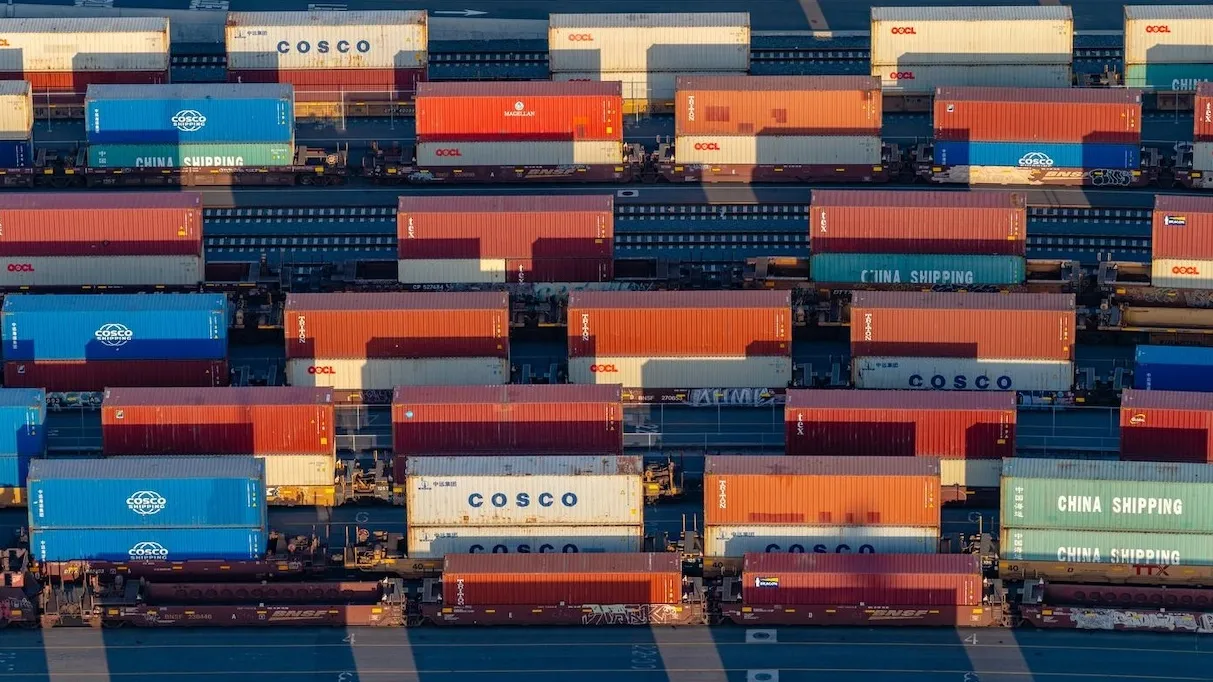
Almost 35,700 import containers had been ready for on-dock trains on the ports of Los Angeles and Lengthy Seaside this week, as file cargo volumes and reported railcar shortages slowed the motion of freight inland.
Of the 35,688 containers awaiting rail service on Oct. 26, 10,562 had been on the terminals for no less than 9 days, based on The Dwell’s compilation of the ports’ every day rail stories. The figures depend particular person containers, relatively than twenty-foot-equivalent models, or TEUs, the usual measure of port cargo quantity.
The backlog was extra extreme at Los Angeles, the place 8,133 of the 19,626 containers awaiting trains had waited 9 days or longer. At Lengthy Seaside, 2,429 of 16,062 rail-bound containers had reached that threshold. That put the share of longer-waiting containers at 41.4% in Los Angeles, in contrast with 15.1% in Lengthy Seaside.
The every day stock figures observe a broader enhance within the time containers spend on marine terminals. Common rail-container dwell throughout the port advanced rose to 7.19 days in September from 6.75 days in August, based on Pacific Service provider Delivery Affiliation information. Common dwell for containers leaving by native truck elevated to three.18 days from 2.95 days.
Each ports dealt with file month-to-month cargo volumes in September. Los Angeles processed roughly 1.04 million TEUs, whereas Lengthy Seaside dealt with 997,177 TEUs. PMSA linked the rise in container dwell to the prolonged peak delivery season and heavy cargo flows.
Freight dealer C.H. Robinson recognized Southern California intermodal railcar shortages as a constraint in its October market replace, saying restricted gear availability was extending import dwell and slowing inland motion. Empty-container repositioning was additionally complicating gear flows, whereas truck-destined containers had been transferring comparatively usually by comparability.
The figures level to explicit strain on the rail aspect of the ports’ operations. The Oct. 26 counts measure containers awaiting on-dock trains at a specific second; they don’t seem to be a median ready time and don’t set up that each container within the stock is overdue.
Class I railroads BNSF (NYSE: BRK-B) and Union Pacific (NYSE: UNP) serve the southern California port advanced.
The buildup of containers on terminals has not been accompanied by proof of a comparable offshore vessel queue. The Dwell’s separate congestion tracker reported one ship awaiting a berth throughout the week of Oct. 26, based mostly on Maritime Administration and Marine Alternate information.
A doable labor disruption may add strain within the coming days. The Pacific Maritime Affiliation warned Oct. 27 {that a} potential Nov. 1 strike involving roughly 250 port watchmen may have an effect on eight container terminals. Members of Worldwide Longshore and Warehouse Union (ILWU) Native 26 voted to approve a walkout as quickly as Sunday.
Based on the employer affiliation, the terminals deal with roughly 85% of Lengthy Seaside cargo and 33% of Los Angeles cargo.
BigRig has reached out for remark from the ports and railroads.
Subscribe to BigRig’ Rail e-newsletter and get the most recent insights on rail freight proper in your inbox.
Learn extra articles by Editor right here.
Learn extra:
Wabtec earnings rise on larger freight and transit gross sales
Union Pacific posts file third-quarter income and income
Norfolk Southern income rise on larger quantity and income
Commodity markets whip up railfreight beneficial properties
First look: Union Pacific earnings
The publish Backlog grows as 35,000 containers await rail service at LA–Lengthy Seaside appeared first on BigRig.