
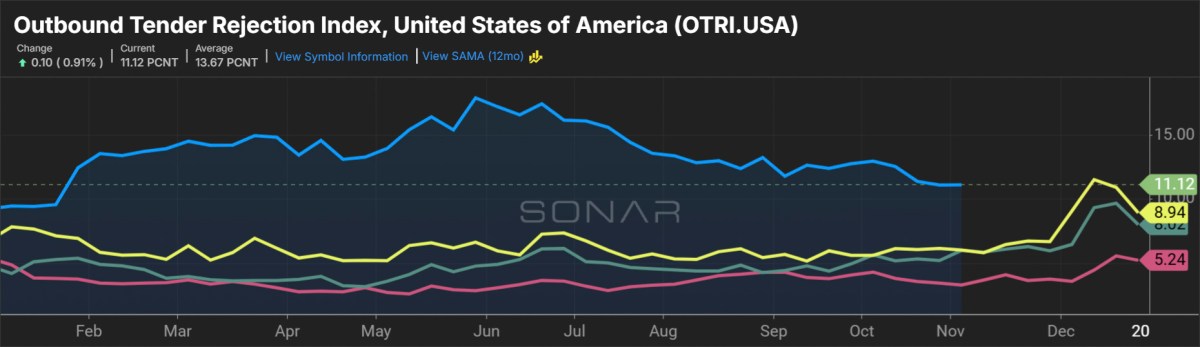
An October survey of provide chain executives confirmed what truckload carriers mentioned on current quarterly calls—that charges are prone to stay on the rise for the foreseeable future. The Logistics Managers’ Index, launched Tuesday, confirmed additional capability declines alongside surging pricing.
Q3 experiences present carriers gearing up for large price will increase
The LMI’s transportation capability dataset registered a studying of 38 for October, an eleventh straight month in contraction, albeit at a tempo that was 3.6 share factors slower than September’s price of decline. (The LMI is a diffusion index during which a studying above 50 signifies enlargement, whereas one under 50 alerts contraction.)
Transportation utilization (63.5) continued to extend, however at a tempo that was 2.6 factors slower sequentially. Upstream firms (producers and wholesalers) returned a 69.3 utilization studying, which was 16 factors larger than downstream retailers.
Transportation costs (88) continued “increasing at a extremely vital price,” however at a tempo that was 4.7 factors slower. (Diesel gas costs have been down 1% sequentially throughout the month, up 70% y/y.)
Whereas value pressures tamped down truckload carriers’ earnings within the third quarter, the group expects to seize double-digit price will increase within the upcoming bid season.
Knight-Swift Transportation (NYSE: KNX), which has roughly 70% of its TL fleet working beneath non-dedicated agreements, is concentrating on “not less than double-digit [rate] will increase” in annual contractual negotiations that simply started. The corporate determined to lean into the spot market earlier this 12 months, which led to tender rejections that have been two to a few instances larger than the business common throughout the third quarter.
A widespread crackdown on noncompliant capability has carriers betting that the restoration is simply starting. Some carriers lately mentioned that they might look to develop their one-way fleets after years of repositioning this tools beneath devoted agreements or disposing of it altogether with a purpose to enhance asset utilization.
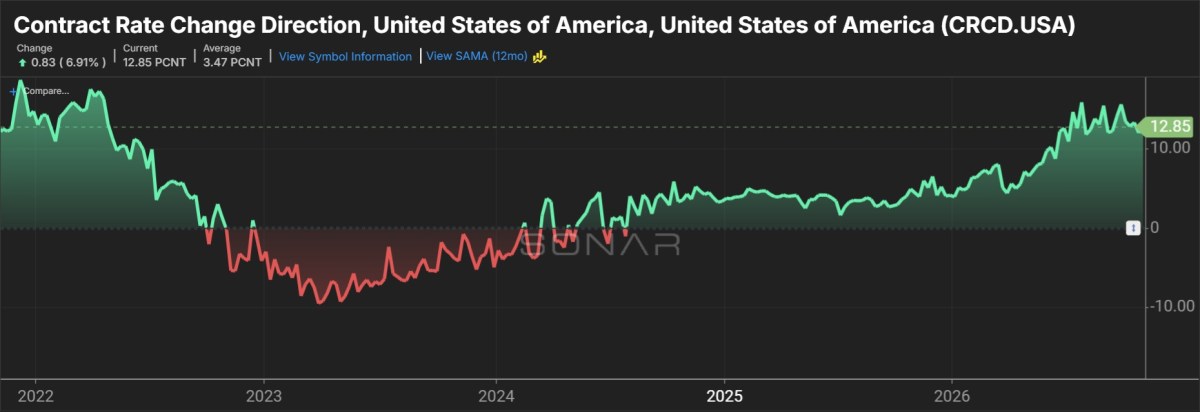
Logistics managers surveyed count on the transportation market to stay very tight over the subsequent 12 months, returning future readings of 49.3 for capability, 67.6 for utilization and 90 for pricing. Whereas the group now expects capability contraction to gradual over the subsequent 12 months (September’s outlook on capability was 37.9), it expects transportation charges to surge quicker (pricing forecast up 3.9 factors sequentially).
Inventories up on hopeful vacation expectations
The general LMI (70.7) was up 50 foundation factors in October to the second-highest degree in over 4 years. June’s 71.1 studying was the best degree recorded over that interval. 12 months-to-date, the index common is the second-highest within the dataset’s 10-year historical past, and roughly 9 factors above final 12 months.
October stock ranges (66.9) jumped 8 factors from September, logging the quickest progress price in 4 years. A 72.1 progress price within the second half of the month was roughly 10 factors larger than the primary half.
“After a 12 months of taking part in issues very cautiously as a consequence of doubts in regards to the shopper and the excessive prices of tariffs and transportation, companies at the moment are pulling inventories in as rapidly as they’ll – typically at excessive prices – in an effort to capitalize on what they hope can be a blockbuster vacation season,” the report mentioned.
Knight-Swift mentioned it’s seeing essentially the most peak-season challenge freight in its community because the pandemic.
Stock Prices (88.8) elevated 8.9 factors to the best studying for the dataset since March 2022.
The change in inventories was evident within the warehousing metrics.
The speed of decline in warehouse capability (43.5) slowed 4.2 factors, however remained firmly in contraction territory. There was no change to capability in January and February; nonetheless, the index has contracted in six of the previous eight months. Upstream firms reported extreme contraction (37.5) whereas downstream companies noticed no change in house availability.
Warehouse utilization (58.8) elevated at a price that was 5.5 factors slower, however warehouse costs (80.7) surged 7.2 factors.
Mixture logistics prices (stock, warehousing and transportation) totaled 257.5, up 11.4 factors sequentially, and the quickest progress price since March 2022—the top of pandemic-fueled shopper spending and the beginning of the warfare in Ukraine. The all-in prices index was 55 factors larger 12 months over 12 months in October.
The LMI is a collaboration amongst Arizona State College, Colorado State College, Florida Atlantic College, Rutgers College and the College of Nevada, Reno, carried out with the Council of Provide Chain Administration Professionals.
Why it issues? The Logistics Managers’ Index supplies a have a look at all main provide chain prices. The most recent report alerts a tough working surroundings for shippers characterised by restricted capability and quickly rising prices.
Extra BigRig articles by Todd Maiden:
- Pamt Corp. experiences Q3 internet loss, books 109.1% truckload OR
- October’s 55.5 manufacturing PMI beats expectations
- Schneider companions with Norfolk Southern; raises outlook regardless of Q3 miss
The submit Peak season stock surge bolsters TL carriers’ double-digit price ask appeared first on BigRig.