
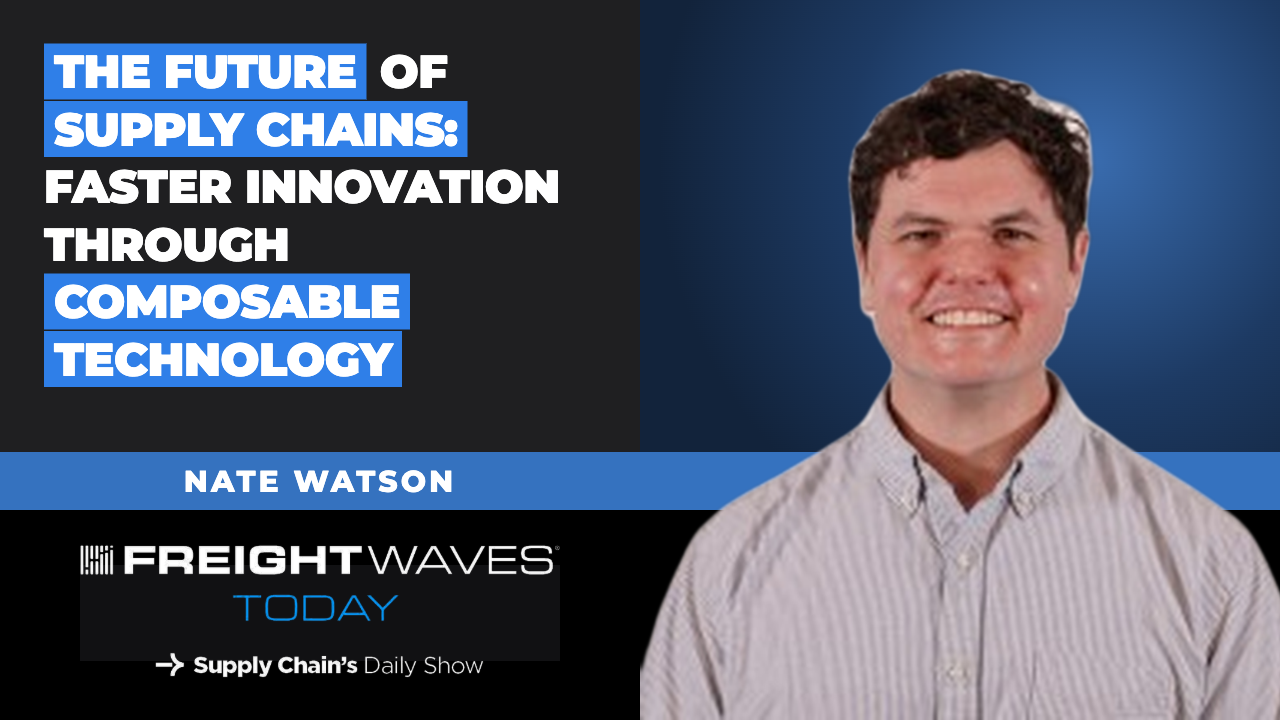
Nate Watson’s case in opposition to the large provide chain software program rollout comes right down to timing. A group can spend 18 months spelling out its processes for a brand new system, he mentioned, and its operations and companions can have modified by the point the system goes reside. The time to worth simply doesn’t make sense.
Watson is chief industrial officer of Vantage 9, a Bentonville, Arkansas, firm that sells what it calls a composable provide chain platform. Its warehousing, stock, order, yard and transportation features come as prebuilt parts that run on prime of an organization’s current ERP, warehouse, and transportation administration programs.
He made the argument in a BigRig At this time interview on Oct. 28 at F3: Way forward for Freight Competition in Chattanooga, Tennessee, the place AI adoption was one of many important themes on the agenda. Audio system saved returning to the identical pressures, Watson mentioned: AI, disruption in software-as-a-service and clients who anticipate their information to be built-in and safe.
“An 18 or 24 month provide chain system venture simply doesn’t make sense given the tempo of change,” Watson mentioned. “In speaking with provide chain leaders, it’s clear that this strategy is gradual, typically runs late, is dear, and pulls employees away from their day jobs.”
The difficulty begins in planning. “You’re employed for 18 months saying, right here’s my course of. Right here’s what I would wish the system to do. Right here’s the info and the reporting that I would wish,” Watson mentioned. “Properly, 18 months in a provide chain is a lifetime. So that you get to that go-live after which abruptly your operations have modified, your companions have modified.”
Customized code or a second vendor
An organization that wants its ERP to deal with 10% greater than it does at this time has two choices, Watson mentioned: customise the system, which takes time and infrequently specialised employees, or purchase the lacking functionality from one other vendor and run two merchandise that don’t talk nicely.
“Customization is synonymous with costly and gradual,” Watson mentioned. “Having the ability to ship the worth of customized on the pace of Saas is the issue Vantage 9 is out to unravel.” Vantage 9 begins from the capabilities a buyer wants, with the info movement and integrations already in place, so its group can focus on the screens operators will use.
“Everybody’s talked about an iterative and agile strategy for years now,” Watson mentioned. “It’s nothing new, however having the programs behind it that will let you ship that functionality is new and is rising.”
Prebuilt items on prime of current programs
Vantage 9 breaks the workload of the big programs into smaller parts and assembles them for every buyer.
“You’ll be able to give it some thought like a Lego set,” Watson mentioned. “We’ve damaged down stock administration, order administration, yard, warehousing, transportation performance that you’d flip to your programs for, and damaged these down into particular person capabilities, like a Lego piece.”
A big retailer may want three completely different warehouse administration setups, Watson mentioned, relying on the kind of constructing and the companions each serves. Every may draw on stock features and connect with the retailer’s transportation system or outdoors companions.
Clients can preserve the programs they already run.
“When you’ve got a system of report that’s doing the job 80 p.c, that’s nice,” Watson mentioned. “With a composable platform, you’re in a position to leverage the perfect of the programs that you have already got in place, after which add in that 5, 10 p.c the place it’s lacking.”
His instance is a retailer that reconfigures a warehouse to deal with product at a brand new temperature. The legacy warehouse administration system might not have been designed for a last-in, first-out setup or for monitoring temperature adjustments. Vantage 9 would add the info administration and the sensor integrations alongside it, he mentioned, and every transportation supplier or provider added after that turns into simpler to attach.
An organization may also begin with one warehouse kind in a single area and take a look at it there with out altering the system that manages the remainder of the community.
Spreading the go-live out
Provide chains run 24 hours a day, seven days every week, and so they can’t shut down for a expertise improve, Watson mentioned.
“A lot of the problem with these giant system implementations is the folks aspect. It’s the adoption. It’s slowing your operations with the intention to go have a go-live for a brand new system or roll out new performance,” he mentioned.
A standard cutover packs that develop into in the future: in Watson’s phrases, “you permit work Friday, work in a technique, you present up Monday.” Including functionality in smaller steps spreads the coaching and alter administration over time and limits the disruption clients see, he mentioned.
“When you’ve got a giant go-live and that’s disruptive to clients, it may be months earlier than you regain that belief. That’s a enterprise killer,” Watson mentioned.
Vantage 9’s implementation group is made up of people that have labored in warehousing and transportation, Watson mentioned, and it spends time on the ground studying “the place’s the pallet loading, who’s working the dock.” That data goes into the final 10% of every venture, the interface warehouse employees really work in.
One layer for folks and AI brokers
Watson sees the composable platform because the place the place AI brokers slot in. An government may run a single course of throughout 5 programs, he mentioned, and what that government cares about is the method and the end result. The platform sits throughout these instruments and units information entry, governance and permissions in a single place.
“So whether or not it’s a human warehouse supervisor or their agent engaged on their behalf, our view is that in a composable platform, entry to that information, the governance round that, the permissions, all must be set at a layer that’s not system-specific, you can commerce out and in these particular programs as wanted as you get higher capabilities from one other,” he mentioned.
From Firebend to Vantage 9
The corporate began in 2019 as Firebend, launched by a group of provide chain operators and technologists from Fort Smith, Arkansas, and spun out of Propak Corp.
Vantage 9 says its deployments are constructed to succeed in measurable return on funding inside 90 days. The corporate says an unnamed nationwide retailer saved greater than $6 million within the first fiscal yr, and it lists a 90% discount in gate processing time and a 700% enchancment in unload occasions amongst its outcomes.
Two questions earlier than a giant buy
Requested what an government ought to take into account earlier than a big provide chain expertise funding, Watson began with whether or not a brand new system is required in any respect. The primary query is whether or not an current system will be modified or enhanced, and whether or not that saves cash or time or helps the group greater than a alternative would.
“Oftentimes we expect, I don’t have the price range or the time to interchange my system. However, should you can leverage what works nicely inside you current system, your focus turns into on small enhancements which might be sooner and less expensive.” The second is what units the corporate as much as preserve bettering over time.
“Nobody is aware of what expertise goes to appear to be in two years, 5 years, ten years’ time,” Watson mentioned. “Being in a posture the place it’s straightforward so that you can carry within the newest and greatest, however have that context of your group and that information layer in place with the intention to leverage new instruments as they arrive out, permits you to experiment and innovate sooner.”
The submit Provide chain software program has an 18-month go-live downside appeared first on BigRig.