
Article delivered to you by Evolutionary Working System, Inc.
For many years, the freight business’s greatest expertise investments have gone to the largest freight firms. Enterprise carriers and mega-brokerages with devoted engineering groups have adopted more and more refined transportation administration techniques and software program integrations. In the meantime, many small-to-medium-sized companies are operating TMS platforms which might be typically a decade or extra outdated. Even when not, they’re sometimes paying enterprise costs for software program that wasn’t constructed round how a smaller operation really runs.
This imbalance is the start line for Evolutionary Working System, Inc. (Evos), an autonomous AI operations firm launching to the general public on October 14. The reasoning, in line with founder and CEO Urav Shah, runs in a reasonably straight line: a long time of expertise funding have gone virtually completely to the enterprise finish of the market, leaving small and mid-size logistics firms operating on getting old techniques that have been by no means constructed round how in another way every of these companies really operates.
These techniques can deal with the routine, predictable share of the work, however not the sting instances, such because the judgment calls that don’t match a typical workflow. That work falls again on an individual to note, resolve and course of by hand. Shah argues that’s created a structural capability drawback for small and mid-size logistics firms, one which’s compounding because the business’s most skilled operators retire and take tacit information with them.
“There’s been twenty to thirty years of huge tech ignoring the small and mid-market,” Shah mentioned. “That’s created an actual capability hole. Evos is the one firm that does the work as a substitute of simply exhibiting you the work.”
What Shah describes is a platform that configures itself round a given enterprise, studying how that firm’s personal crew makes use of judgment to work by way of its edge instances, then dealing with that work on their behalf reasonably than merely flagging it for an individual to complete.
That’s the execution layer, and it’s how Shah attracts the road between Evos and the wave of AI copilots and assistants now constructed into most main TMS platforms. These instruments nonetheless want somebody to drive them, they usually’re largely unequipped to deal with the sting instances that make up an enormous portion of day-to-day duties in smaller operations. Some AI brokers may counsel a standing replace or flag an exception, however an individual nonetheless has to behave on it.
As a result of Evos was designed to be an execution layer, it will possibly assist run total desks, akin to dispatch, track-and-trace, or billing, finish to finish, on prime of a company’s present techniques.
The largest problem, in line with Shah, isn’t just constructing software program that may act. It’s constructing software program that acts the best way a selected firm would. Each logistics operation runs a little bit in another way, and that variation reveals up continuously within the edge instances that devour an ops crew’s day.
Shah gave an instance of the form of interrogation Evos runs throughout onboarding to seize that logic. Why did a given load go on one truck as a substitute of one other out there one? As a result of that buyer will get precedence service. Why not the newer truck? As a result of it was already dedicated to a spot load with tighter lead time. Multiply that by each recurring judgment name a dispatcher makes, and the sample of conduct is the configuration knowledge that lets Evos’ autonomous operator match the particular execution wants of that one firm reasonably than making use of a generic workflow throughout each buyer.
In a deliberate architectural selection, Evos runs what it calls massive motion fashions reasonably than massive language fashions. The system is educated on patterns of selections and conduct reasonably than on textual content. Each buyer has its personal mannequin, educated solely on that firm’s personal historic knowledge, with no shared central mannequin pooling data throughout prospects. Reinforcement studying occurs on anonymized behavioral patterns particular to that one operation.
Shah mentioned the strategy is a direct response to a hesitation he hears continuously from smaller operators: reluctance at hand over proprietary operational information to an exterior AI platform. Protecting every buyer’s mannequin self-contained signifies that tribal information stays tribal. It’s neither contaminated by the best way different firms behave nor prone to any IP infringements.
Shah additionally factors to how Evos builds these fashions as an additional differentiator from different point-solution automations. Most of these instruments run on prime of frontier massive language fashions from main AI labs, which ties their underlying prices to no matter these labs are charging at any given time. As a result of Evos trains and runs its personal fashions reasonably than routing requests by way of a frontier mannequin, Shah argues its value construction stays fastened as a substitute of uncovered to that volatility, which he expects to matter extra as frontier-model pricing ultimately shifts to replicate what these labs really spend on compute.
Tacit information retention extends to how Evos is addressing the business’s getting old workforce. As ops groups across the nation wrestle to switch skilled expertise, Evos has constructed a option to protect what a retiring dispatcher or fleet supervisor is aware of earlier than it disappears from the enterprise completely, and expanded the capability of present groups within the course of. That features issues just like the escalation logic, the workarounds, and the choice standards that have been by no means written down for a brand new rent to be taught.
None of that works, although, if deployment takes the months typical of an enterprise software program rollout. Evos says a brand new autonomous operator can go reside in below 24 hours from first dialog, with out migrating a buyer’s present knowledge, utilizing a library of greater than 150 pre-built integrations with widespread freight techniques.
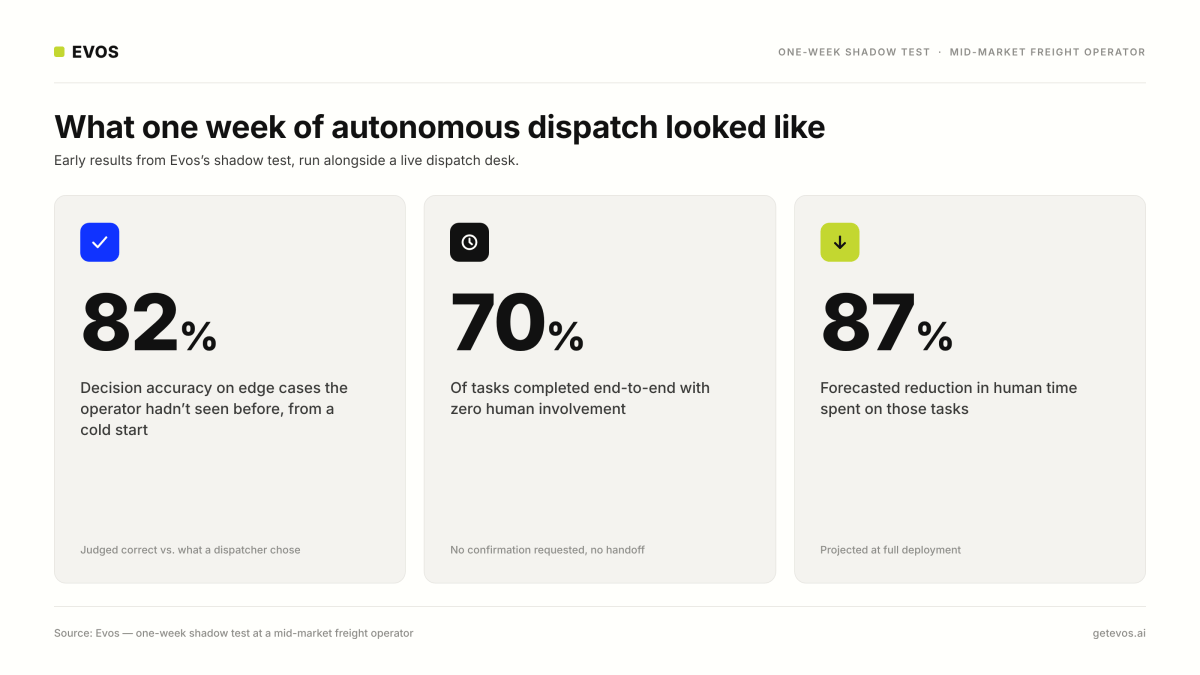
Shah described a graduated-autonomy mannequin for a way these operators earn belief as soon as deployed: a brand new operator begins by dealing with a portion of a workflow autonomously whereas routing judgment calls to a human for approval, rejection, or revision, and the system causes from these revisions going ahead. If it’s advised as soon as to keep away from an older truck that wants extra frequent gasoline stops on a tight-deadline load, it will possibly begin weighing that very same tradeoff on future masses with out being advised once more.
As an illustration of the form of drawback Evos is constructing towards for smaller carriers particularly, Shah pointed to an operator at the moment in improvement that scans a service’s deliberate routes for backhaul alternatives (a truck headed from Chicago to New York with nothing booked for the return leg, for instance) and surfaces a set of matching masses for a dispatcher to verify. At this time, he mentioned, that form of open capability is normally discovered manually, usually scrambled collectively on the final minute, if it’s discovered in any respect.
Most AI instruments nonetheless want fixed prompting: somebody has to ask, overview, and act on each reply. An Evos operator is given a operate, not a immediate, so the crew finally ends up managing outcomes as a substitute of inputs.
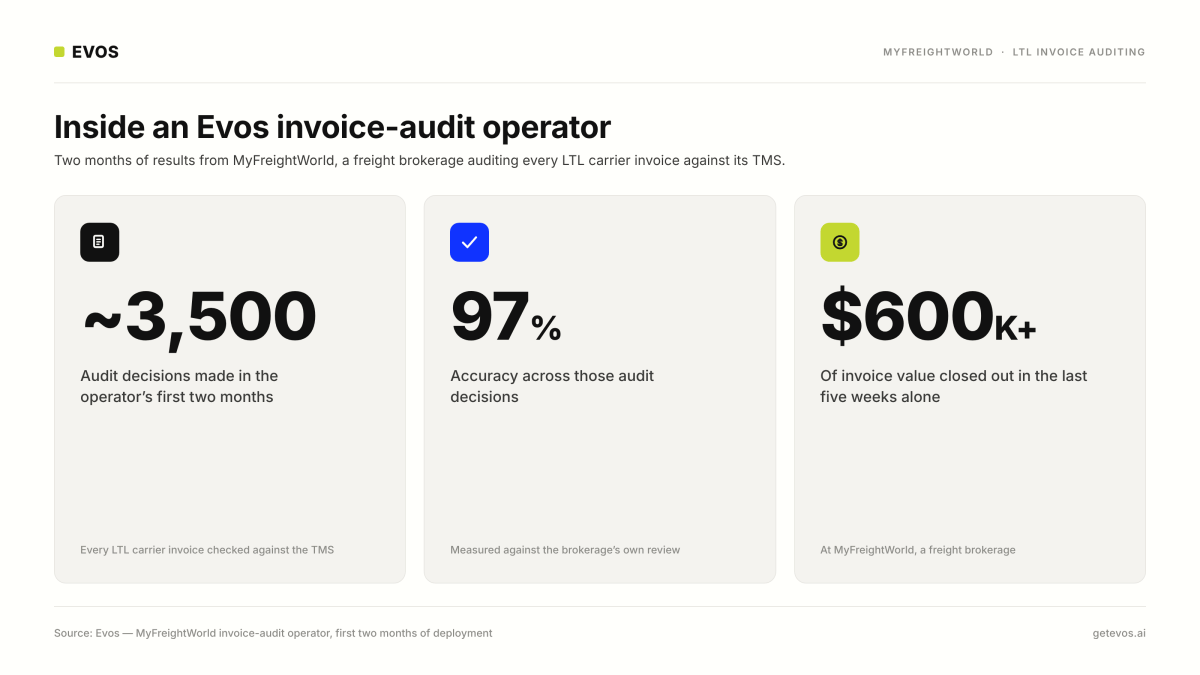
One freight brokerage, MyFreightWorld, runs an Evos operator that audits each LTL service bill towards its TMS. In its first two months, the operator made practically 3,500 audit selections at 97% accuracy, and within the final 5 weeks alone it has closed out greater than $600,000 of bill worth.
“Evos has helped us revolutionize our billing course of with zero upfront funding, and in addition at an impressively quick velocity measured in days and weeks,” mentioned Mike Chalfant, president of MyFreightWorld. “It’s elevated our accuracy and dramatically elevated effectivity, which has in the end led to a greater expertise for our buyer base. The efficiency of the operator has given us confidence and pleasure to proceed so as to add to the performance and discover new potentialities. Including Evos to the stack has been a terrific factor for our firm, and we’re excited to proceed to develop our partnership.”
These numbers level again to the identical argument, in line with Shah. The expertise hole in freight software program is basically the results of who enterprise distributors constructed for.
“We’re the one firm that does the work as a substitute of simply exhibiting you the work,” Shah mentioned. Whereas the biggest carriers are already investing closely in automation, the small and mid-size operators want a tailor-made resolution they gained’t discover elsewhere.
That’s why, in line with Shah, Evos’ autonomous operators are designed to assist the logistics companies most uncovered to the business’s capability hole and the probably to lose institutional information as their veteran workers retire.
Click on right here to be taught extra about Evos.
The submit What Occurs to Tribal Data When Dispatchers Retire? appeared first on BigRig.